

The Round of 32 at the 2026 FIFA World Cup has completely shattered the illusion that there are any easy games left on North American soil. If the earlier fixtures this week taught us anything about the expanded format, it is that historical pedigree means absolutely nothing when you are standing on the pitch in a single-elimination war.
Today, July 3, 2026, delivered a trifecta of matches that showcased exactly what it takes to survive in this tournament. We witnessed a surgical dismantling in Los Angeles, a grueling European streetfight in Toronto, and a display of cold, mechanical efficiency in Vancouver. As the bracket narrows and the pressure becomes suffocating, the true contenders are separating themselves from the pretenders.
Let's strip away the diplomatic post-match press conferences and look at the brutal tactical realities of today’s results. Here is my unfiltered breakdown of how Spain, Portugal, and Switzerland booked their tickets to the Round of 16, and what it means for the rest of the footballing world.
The Spanish Inquisition: A 3-0 Slaughter in Los Angeles
When Spain walked onto the pitch at the Los Angeles Stadium against Austria, there were lingering questions about their ability to turn possession into penetration. For years, the Spanish national team has been accused of "death by a thousand passes" dominating the ball but failing to deliver the lethal final blow. Today, they silenced those critics with a terrifying 3-0 victory that felt more like a training ground exercise than a World Cup knockout match.
Tactical Suffocation
From the opening whistle, Spain did not just hold the ball; they weaponized it. They utilized a hyper-aggressive 4-3-3 system that completely isolated the Austrian midfield. Austria, hoping to sit in a low block and strike on the counter, found themselves chasing ghosts. The Spanish midfield trio rotated with such fluidity that the Austrian pressing triggers were entirely scrambled.
What made this performance so frightening was the verticality. Spain didn't just cycle the ball horizontally in a U-shape around the Austrian defense. They actively looked to break lines. By the time Austria finally lost their discipline resulting in a desperate 83rd-minute yellow card as they chased shadows—the game was already dead and buried.
Spain looks incredibly dangerous. They have married their traditional possession-based identity with a newfound ruthlessness in the final third. If you are an upcoming opponent, this tape is going to cause nightmares. You cannot press them because they will pass around you, and if you sit deep, they now possess the cutting edge to tear you apart.
The Grinding Machine: Portugal Survives Croatia 2-1
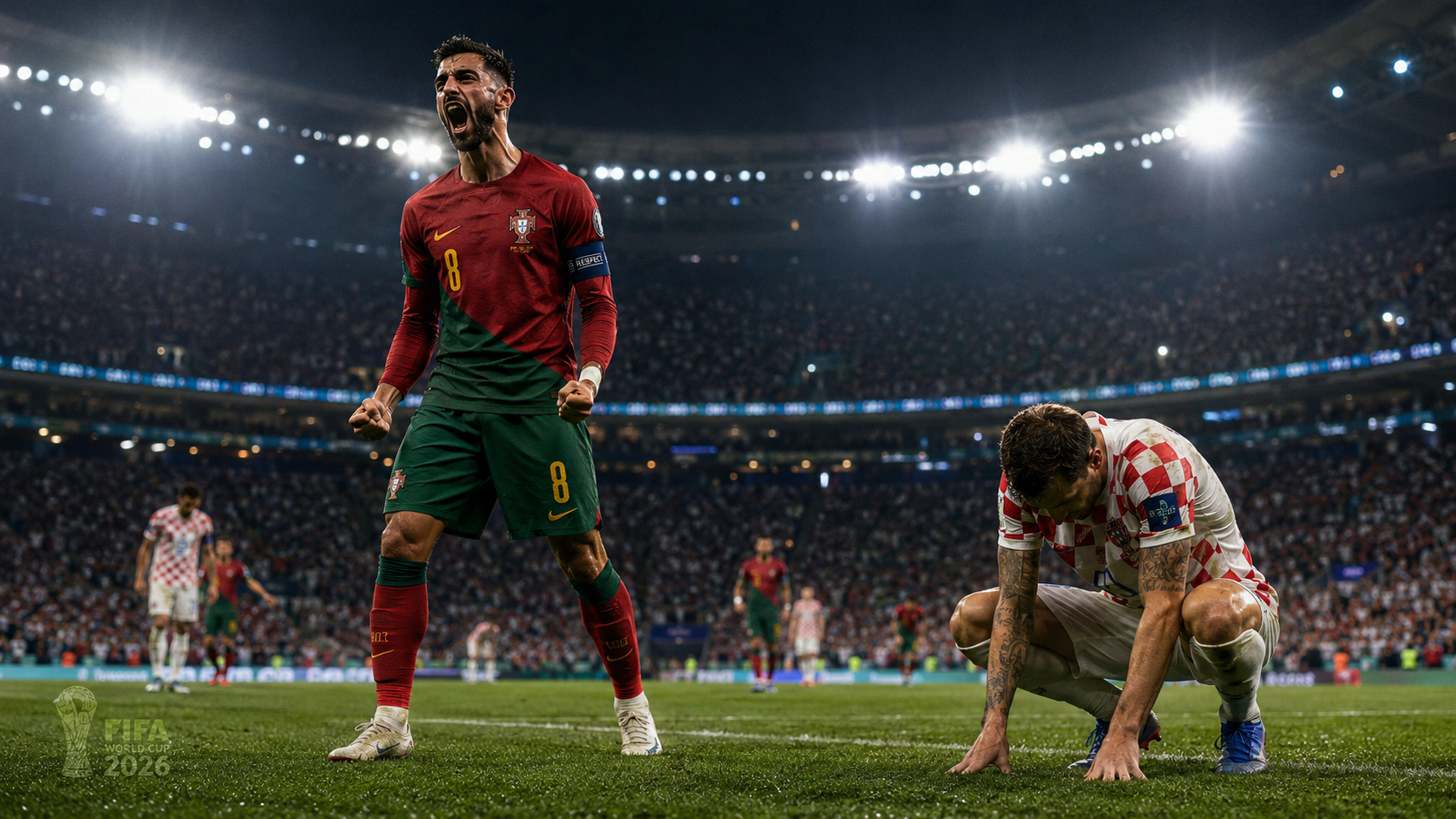
While Spain was busy painting a masterpiece in California, a brutal, exhausting heavyweight fight was unfolding at the Toronto Stadium. Portugal’s 2-1 victory over Croatia was not pretty. It was not elegant. But in tournament football, aesthetics do not win trophies survival does.
A War of Attrition in the Midfield
This match was won and lost in the central third of the pitch. Croatia, armed with their perennial technical brilliance in the midfield, attempted to dictate the tempo and slow the game down to a crawl. Portugal, however, refused to play on Croatian terms. They turned the match into a physical, transitional battle.
The disciplinary record of the match tells the entire story. Portugal picked up a cynical yellow card just 17 minutes in to set the physical tone and disrupt a Croatian counter-attack. Croatia responded in kind, picking up a booking in the 59th minute as the fatigue of chasing the Portuguese wingers set in.
The climax of the match was pure, unfiltered tension. Leading 2-1 in the dying moments, Portugal dropped into a resolute defensive shell. Croatia threw absolutely everything forward, culminating in a desperate, chaotic final eight minutes of stoppage time. A 98th-minute yellow card for Croatia highlighted the sheer frustration of a team watching their World Cup dreams evaporate. Portugal did not play beautiful football today, but they demonstrated an immense psychological resilience that is absolutely mandatory for a championship run. They know how to suffer, and they know how to win ugly.
Swiss Precision: Clinical 2-0 Dismantling of Algeria
If you want a textbook example of how to execute a game plan with zero emotional interference, go rewatch Switzerland’s 2-0 victory over Algeria at BC Place in Vancouver. The Swiss are the quietest assassins in this tournament, and today, they were utterly flawless.
The Anatomy of a Perfect Game Plan
Algeria came into this match with immense momentum, bringing a vibrant, chaotic energy that can easily overwhelm rigid European structures. Switzerland’s manager clearly anticipated this and deployed a system designed to instantly extinguish the Algerian fire.
The match was functionally over in the first ten minutes. In the 10th minute, Breel Embolo shattered the Algerian defensive line, finishing a clinical move that required a tense VAR review before being officially awarded. That early goal completely altered the psychology of the match. Algeria, forced to abandon their reactive counter-attacking strategy, had to take the initiative.
Switzerland simply absorbed the pressure and waited for the inevitable gaps to appear. Just one minute into the second half, Dan Ndoye delivered the killing blow in the 46th minute, another goal validated by VAR. From that point on, it was a masterclass in game management. The Algerian frustration boiled over, resulting in yellow cards for Farès Chaïbi (36') and Hicham Boudaoui (72'). Switzerland committed zero defensive errors, picked up zero cards, and booked their spot in the Round of 16 without breaking a sweat.
Verified July 3 Match Analytics & Performance Data
To truly understand the gap between the victors and the vanquished today, we have to look at the raw data. The following table provides the verified, definitive metrics from today's completed knockout fixtures.
| Fixture | Final Score | Venue | Key Goalscorers / Moments | Disciplinary Actions | Match Phase Resolution | ||
| Spain vs. Austria | 3 - 0 (Spain) | Los Angeles Stadium | Spain dominant attacking clinic | AUT: Yellow Card (83') | Regular Time (90') | ||
| Portugal vs. Croatia | 2 - 1 (Portugal) | Toronto Stadium | Gritty transitional battle | POR: Yellow (17') | CRO: Yellows (59', 90+8') | Regular Time (90') | |
| Switzerland vs. Algeria | 2 - 0 (Switzerland) | BC Place Vancouver | SUI: B. Embolo (10'), D. Ndoye (46') | ALG: F. Chaïbi (36'), H. Boudaoui (72') | Regular Time (90') |
(Note: All matches concluded within standard regulation time, highlighting a definitive gap in quality that avoided the chaos of extra time and penalty shootouts seen earlier in the week.)
Looking Ahead: The Evening Clash in Dallas
While the morning and afternoon gave us three distinct flavors of European triumph, today is not over. Later tonight, the focus shifts to the blistering heat of Texas as the Dallas Stadium hosts the final scheduled match of the day: Australia vs. Egypt (Kickoff at 23:30 User Time).
This is a profoundly fascinating tactical matchup. Egypt will rely heavily on their structured defensive organization and the explosive pace of their wide forwards in transition. Australia, conversely, brings a rugged, unapologetic physicality to the pitch. The Socceroos excel at set-pieces and aerial duels, and they will look to turn this match into a bruising, physical contest in the middle of the park.
If Egypt tries to play out from the back, Australia's high press could force catastrophic errors. If Australia overcommits, Egypt has the speed to punish them instantly. Given the stakes, I do not expect a high-scoring affair. This will likely be a nervous, cagey 1-0 result decided by a single mistake or a moment of individual brilliance late in the second half.
As the dust settles on the July 3 fixtures, the landscape of the 2026 World Cup is coming into sharp focus. The expanded 48-team group stage allowed for Cinderella stories and shocking upsets, but the Round of 32 is acting as a brutal filter.
What we saw today from Spain, Portugal, and Switzerland was the reassertion of elite tournament pedigree. You cannot survive in this phase of the competition on raw emotion or chaotic energy alone. You need the tactical sophistication of the Spanish, the gritty, street-fighting mentality of the Portuguese, or the icy, mechanical precision of the Swiss.
The teams that advanced today did not just win; they sent a clear message to the rest of the bracket. The training wheels are off. The margin for error is absolute zero. If your tactical structure has a flaw, the elite teams left in this tournament will find it, exploit it, and send you packing. The Round of 16 is shaping up to be an absolute bloodbath, and based on what we witnessed today, only the truly ruthless will survive.