

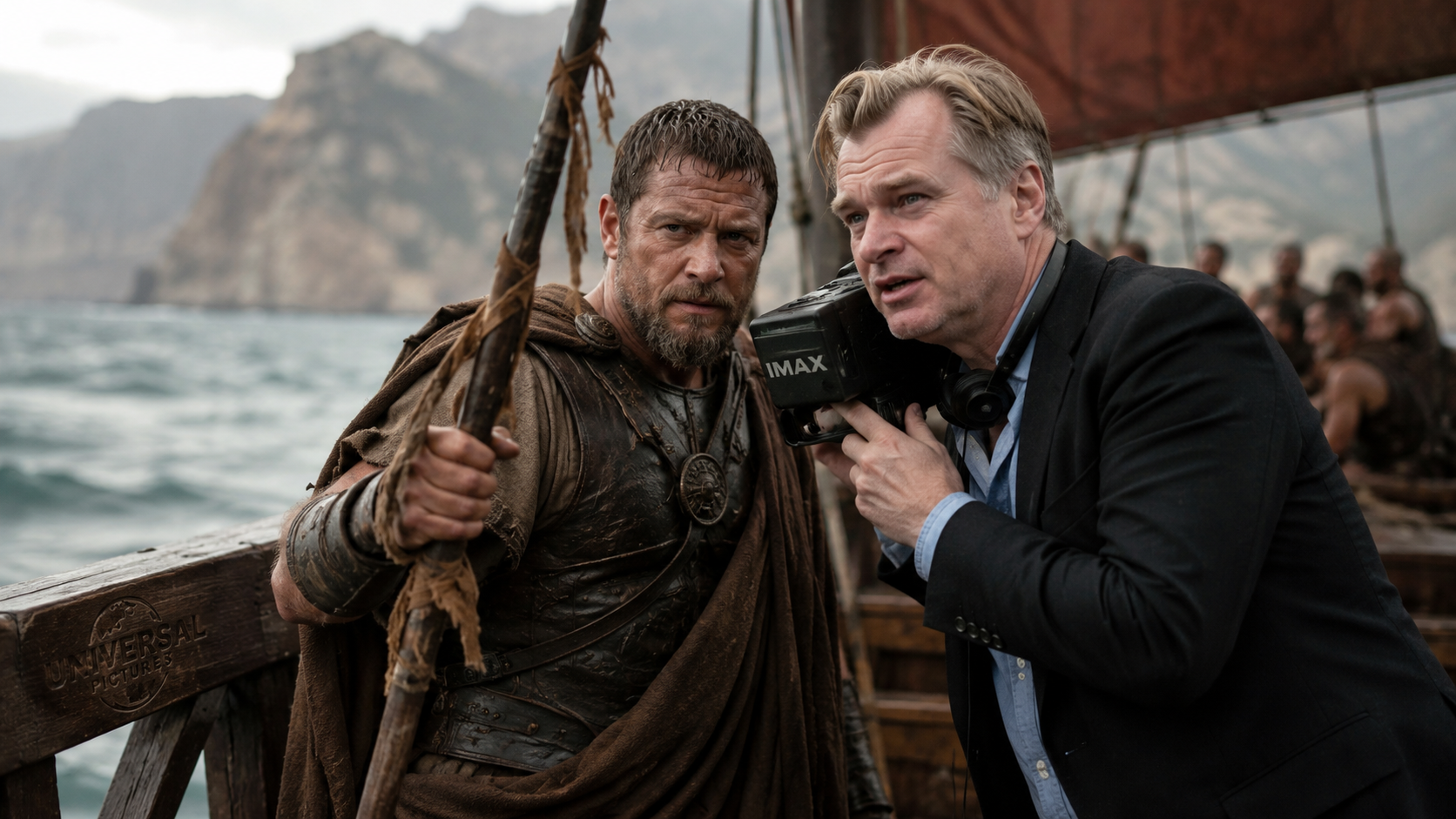
I sat in a packed IMAX theater on a Thursday night in mid-July, watching a 70mm projection of ancient Greek triremes crashing through photorealistic waves, and I realized something fundamental about the current state of Hollywood: Christopher Nolan is no longer just a filmmaker. He is an entire macroeconomic stimulus package for the theatrical industry.
The release of The Odyssey, Universal’s $250 million gamble on Homer’s classical poem, is a staggering achievement not just in terms of visual storytelling, but as a sheer commercial force. We have spent the last three years wondering if the monumental success of 2023’s Oppenheimer was a fluke a perfect storm generated by the cultural meme-ification of "Barbenheimer." It wasn't. What Nolan has done with The Odyssey proves that adult-skewing, auteur-driven, maximalist cinema can go toe-to-toe with established mega-franchises. And the box office numbers coming in this weekend are nothing short of breathtaking.
The Box Office Reality: Dominating 2026
Let’s cut right to the hard data. Universal Pictures and Christopher Nolan have essentially orchestrated the most robust live-action opening of the year. According to the early weekend tracking, The Odyssey is projected to pull in an estimated $117 million across 3,919 theaters domestically over its first three days. That number is staggering for a film that is fundamentally an ancient Greek tragedy lacking the built-in merchandise appeal of a Marvel superhero or an animated Pixar sequel.
Thursday preview numbers gave us the first hint of the impending massive turnout. The film generated a colossal $17.6 million in U.S. previews alone, marking the best preview gross for any movie in 2026 so far. To put that into perspective, The Odyssey immediately dwarfed the $82.4 million opening weekend of Oppenheimer. The ticket demand is so severe that it entirely deflected the expected marketplace hit from the FIFA World Cup final between Argentina and Spain happening on the exact same weekend. Box office analysts initially worried that international sporting events would cannibalize ticket sales, but Nolan’s audience operates on a completely different wavelength. When a new Nolan film drops in IMAX, sports take a back seat.
The international footprint is equally aggressive. In the UK, the BFI IMAX reported a record-shattering 28,000 tickets sold in a single 24-hour period, bringing in a gross of £750,000 and easily outpacing Oppenheimer’s presales by nearly triple the volume. Over in India, the epic sailed past ₹17 crore on its opening day, securing the 11th highest pre-sales for a Hollywood film in the country's history. The global bow is eyeing the $200 million-plus mark, and given the standard Nolan box office multiplier, we are looking at a film destined to challenge the $1 billion threshold globally before the end of August.
A Look at the Numbers: Nolan's Track Record
To truly understand the gravity of a $117 million opening for an ancient Greek adaptation, you have to look at it within the context of Nolan's own career. Only his peak Batman franchise films have opened higher.
Christopher Nolan's Top 5 Domestic Box Office Openings
| Rank | Film Title | Release Year | Domestic Opening Weekend | Box Office Context |
| 1 | The Dark Knight Rises | 2012 | $160.8 Million | Franchise peak; highly anticipated trilogy conclusion |
| 2 | The Dark Knight | 2008 | $158.4 Million | Propelled by historic critical acclaim and Ledger's performance |
| 3 | The Odyssey | 2026 | $117.0 Million | Estimated; best live-action opening of 2026 |
| 4 | Oppenheimer | 2023 | $82.4 Million | R-rated, dialogue-heavy historical biopic |
| 5 | Inception | 2010 | $62.7 Million | Completely original sci-fi intellectual property |
This table tells a distinct story. The Odyssey isn't leaning on the crutch of an established cinematic universe. It relies entirely on the brand equity of its director and the sheer, terrifying scale of its ambition.
The Specs: What Makes 'The Odyssey' a $250 Million Beast
From a production standpoint, Nolan has never operated on this scale. Emma Thomas, Nolan’s long-time producing partner and wife, downplayed reports earlier this year that it was their most expensive film, but at an estimated $250 million, it certainly carries the heaviest financial risk. Here is exactly what Universal financed for this massive undertaking:
- Director/Writer: Christopher Nolan
- Source Material: Homer’s classical Greek epic poem, The Odyssey
- Production Budget: $250 Million
- Format: Shot entirely on IMAX 70mm film cameras (using a reported 2 million feet of film stock)
- The Cast: Matt Damon (Odysseus), Tom Holland, Anne Hathaway, Robert Pattinson, Lupita Nyong’o, Samantha Morton, Zendaya, and Charlize Theron
- Studio: Universal Pictures (Continuing the lucrative partnership established post-Warner Bros. fallout)
- Key Achievement: Achieved IMAX's highest pre-sales of all time globally.
The IMAX Cult and Technical Obsession
As a film purist, I have to address the physical format. Christopher Nolan’s insistence on shooting with heavy, deafening 70mm IMAX cameras is well documented, but The Odyssey takes it to an entirely new echelon. This is the first feature film to be shot entirely on IMAX cameras. The visual fidelity on display is incomprehensible until you are sitting in front of a six-story screen.
The marketing around the 70mm experience has created a manufactured scarcity that drives ticket sales in a way digital projection simply cannot. We are seeing reports of fans driving across the country some even jokingly delaying major life events, just to secure center-row seats at one of the few true 15/70mm IMAX locations left in the world. It’s brilliant marketing disguised as artistic integrity. You aren't just buying a movie ticket; you are buying admission to a limited-time cultural event.
When you watch Matt Damon’s Odysseus navigating the treacherous waters toward Ithaca, the aspect ratio expands, your seat rattles with the heavy bass of the practical sound design, and the screen is filled with an analog warmth that makes modern, green-screened superhero movies look entirely sterile. It justifies the exorbitant ticket prices.
My Perspective: The Cast and The Narrative
I was initially skeptical when I saw the casting sheet. Matt Damon is a phenomenal actor, but placing him as the defining Greek hero of antiquity felt like a massive risk. We are used to seeing Damon as the grounded everyman, the guy we have to save in The Martian or Saving Private Ryan. But Nolan uses that exact vulnerability to his advantage. Damon’s Odysseus isn't a flawless, marble-chiseled god; he is a battered, exhausted general desperate to get home. It’s a soulful performance that anchors the film’s massive $250 million spectacle.
Then there is the supporting cast. Zendaya and Tom Holland bring a necessary youth demographic appeal, but they aren't just shoehorned in for social media engagement. Their performances are raw and stripped of their usual Hollywood glamour. Robert Pattinson and Anne Hathaway, both Nolan veterans at this point, chew the scenery exactly where required, blending seamlessly into the brutal, mythical world.
Some critics have pointed out that the film heavily sidelines nuanced female perspectives in favor of a masculine journey of endurance, which is a fair critique of both Homer’s original text and Nolan's historical blind spots. However, the film never pretends to be a modern deconstruction. It is a straight, terrifying, and awe-inspiring adaptation of men, monsters, and moral metamorphosis.
How 'The Odyssey' Redefines the 2026 Hollywood Landscape
Let’s zoom out and look at the broader industry. 2026 is officially the year the movie business came roaring back. After the debilitating dual Hollywood strikes of 2023 and the subsequent dry spells, the studios finally got their production pipelines flowing at full capacity.
Paul Dergarabedian, the head of marketplace trends at Rentrak, recently noted that the summer box office is tracking to be the best since the pre-pandemic highs of 2019. We have seen roughly $2.5 billion in sales since the first Friday in May. Universal is having a monster year. Between The Super Mario Galaxy Movie, the Michael Jackson biopic Michael, and now The Odyssey, they are practically printing money. Disney is also holding its ground with guaranteed heavy-hitters like Toy Story 5 and the live-action Moana, while Sony and Marvel prepare to drop Spider-Man: Brand New Day.
But The Odyssey represents something far more vital to the health of the industry than an animated sequel or a superhero entry. Tim Richards, chief executive of Vue Cinemas, said it perfectly when he declared, "When I say we are back... we are back". The fact that a three-hour, adult-oriented classical epic can open to $117 million domestically proves that audiences aren't inherently fatigued by cinemas; they are fatigued by mediocrity.
We are currently witnessing a massive paradigm shift. The era of the guaranteed $150 million superhero opening is waning. Audiences have spent the last five years becoming highly selective. They want event cinema. They want films that demand to be seen on the biggest screen possible, with sound that vibrates their ribcages. Nolan understands this better than any studio executive in California. He knows that if you give people a genuine spectacle, rooted in practical filmmaking and helmed by top-tier acting talent, they will show up in droves.
Comparing the Competition: The 2026 Summer Slate
To appreciate the unique nature of Nolan's success, we have to look at the other films defining the 2026 box office. The year is currently dominated by safe intellectual property. The Super Mario Galaxy Movie capitalized on the massive nostalgia and family-friendly goodwill of its predecessor to effortlessly cross $429 million domestically. Toy Story 5 is tracking to hit an identical stratosphere, proving that Pixar's legacy characters still hold a tight grip on millennial parents and their children. Even Minions & Monsters is hovering comfortably near the top of the summer charts.
However, these films target the four-quadrant family demographic. The Odyssey, much like Oppenheimer and Dunkirk before it, targets older teenagers, adults, and cinephiles. Its only real competition for the adult dollar this summer comes from mid-budget horror outings like Evil Dead Burn or A24’s The Invite. When you place The Odyssey next to Marvel's highly anticipated Spider-Man: Brand New Day or Avengers Doomsday, you realize Nolan is offering the only premium live-action alternative to the superhero genre. He has essentially monopolized the prestige blockbuster lane.
Production Design and Practical Effects
I must also highlight the technical wizardry that makes the $250 million budget visible in every single frame. We live in an era where massive budgets are usually spent on rushed, weightless CGI environments engineered in a post-production house. Nolan famously rejects this approach. The decision to build massive, practical sets of ancient Greek vessels and utilize in-camera effects for the mythical elements grounds the fantasy in a gritty, tactile reality.
When you see a storm tearing a ship apart in this movie, you are watching real water, real actors, and practical physics captured on the highest resolution film stock available to humanity. It creates a subconscious weight that digital pixels simply cannot replicate. This commitment to practical filmmaking is exactly why Christopher Nolan commands the box office in a way his contemporaries do not. He respects the audience's intelligence and their hard-earned money.
Looking ahead, the legs on The Odyssey are going to be marathon-level. With virtually no direct adult-skewing competition entering the market over the next three weeks, expect standard week-to-week drops of less than 35%. I confidently project The Odyssey will finish its domestic run somewhere in the neighborhood of $385 million to $415 million, with a global total comfortably pushing past $1 billion. Universal Pictures bet a quarter of a billion dollars on Christopher Nolan’s vision of a 3,000-year-old poem. It sounded insane on paper. Today, it looks like the smartest financial decision of the decade.