

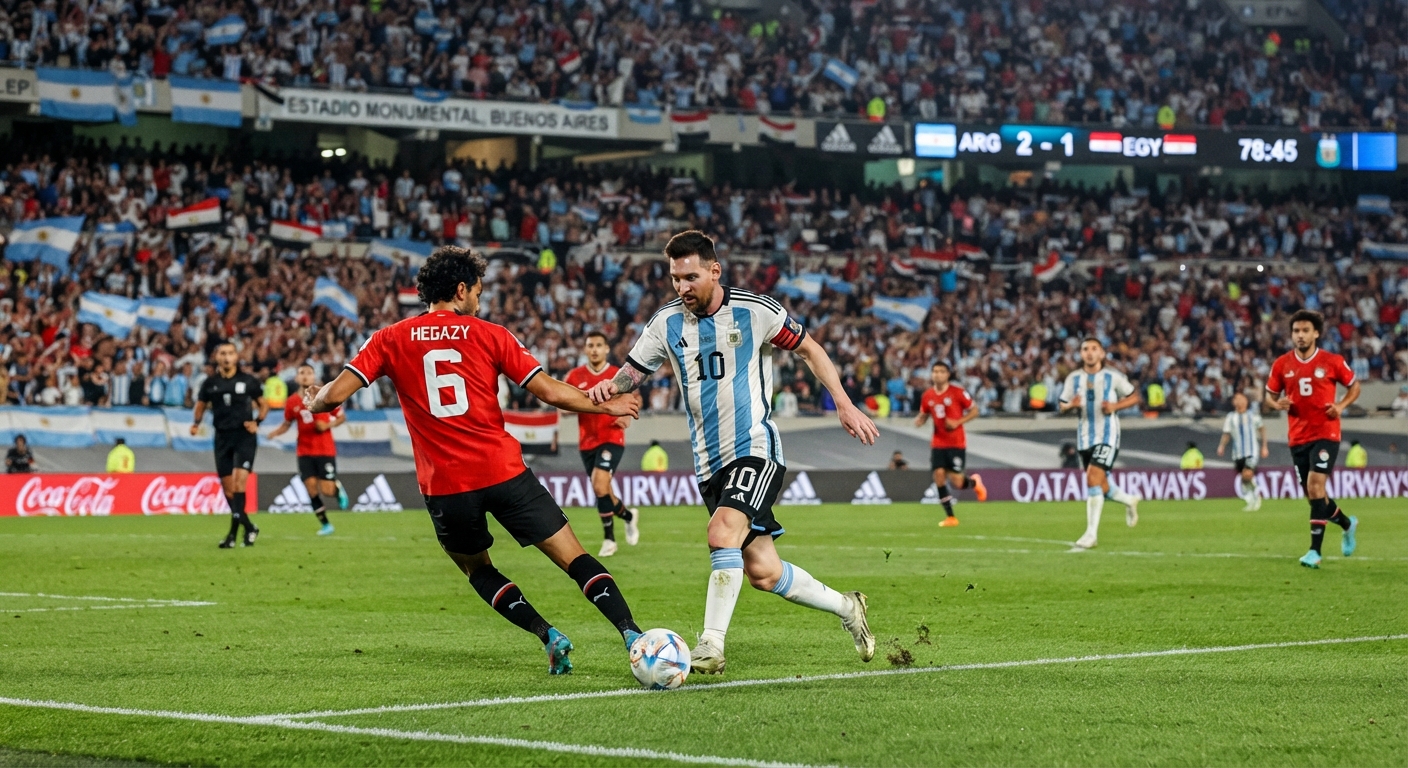
Football has a unique way of making fools out of tactical purists. For 78 minutes at the Atlanta Stadium, the script for this Round of 16 match was written in stone. Egypt, an unheralded but terrifyingly organized collective, was on the verge of engineering the greatest shock in modern World Cup history. They were leading the reigning world champions 2-0, exposing a sluggish, predictable Argentine squad that looked entirely devoid of ideas, energy, or structural solutions.
Then, the chaotic essence of tournament football took over. Within a frantic fourteen-minute window, Lionel Scaloni’s men cast aside their rigid positional play, embraced pure desperation, and mounted a breathtaking three-goal comeback. Argentina's 3-2 victory will go down as an instant classic, but it raises deeply unsettling questions about the structural integrity of the champions. It was a match defined by a shocking penalty miss, tactical naivety, and a late-game emotional explosion that rescued Argentina from what would have been an epochal disaster.
The Monotonous Grid vs. The Low Block: Tactical Formations
To understand how Egypt managed to choke the life out of Argentina for nearly eighty minutes, we must examine the starting lineups and the mechanical setups deployed by both managers. Lionel Scaloni opted for an asymmetrical 4-1-3-2 configuration that, in theory, was designed to maximize central overloads. In practice, it turned out to be an incredibly narrow, sluggish machine that played right into Egypt's hands.
Starting Lineups and Formations
| Team | Tactical Shape | Goalkeeper | Defensive Line | Midfield Core | Attacking Unit |
| Argentina | 4-1-3-2 | Emiliano Martínez | N. Molina, C. Romero, L. Martínez, N. Tagliafico | L. Paredes (DM), R. De Paul, E. Fernández, A. Mac Allister | L. Messi, J. Alvarez |
| Egypt | 4-2-3-1 | Mostafa Shobeir | M. Hany, R. Rabia, Y. Ibrahim, K. Hafez | M. Attia (Defensive), M. Lasheen (Defensive), E. Ashour | H. Hassan (W), M. Salah (W), M. Ziko (ST) |
Argentina’s reliance on Leandro Paredes as a single pivot meant that Rodrigo De Paul and Enzo Fernández had to push incredibly high into the half-spaces. Because full-backs Nahuel Molina and Nicolás Tagliafico failed to provide genuine, overlapping width in the final third, Argentina became entirely predictable. They continuously attempted to play short, intricate passes through a central channel that Egypt had completely blocked with a mountain of disciplined bodies.
Egypt’s 4-2-3-1 operated with flawless coordination. Marwan Attia and Mohanad Lasheen formed an iron double-pivot that sat directly in front of their center-backs, effectively isolating Alexis Mac Allister and forcing Lionel Messi to drop dangerously deep—sometimes even behind his own midfielders—just to get a touch of the ball. Up front, Mostafa Ziko led the line with relentless defensive work rate, ensuring that Cristian Romero and Lisandro Martínez could never comfortably build play from the back.
First Half: The Penalty Ghost and Ibrahim's Statement
The match began with Argentina dominating possession, circulating the ball with a slow, ponderous rhythm that felt completely unsuited for a World Cup knockout tie. Egypt remained unfazed, compact, and ready to strike on the transition. The first massive shock hit the stadium in the 15th minute.
Egypt won a corner on the left flank after a rare counter-attack forced Nahuel Molina into a hurried clearance. Karim Hafez swung a wicked, outswinging delivery into the heart of the six-yard box. The Argentine zonal marking system completely collapsed. Yasser Ibrahim timed his run to perfection, escaping the loose marking of Leandro Paredes to power a thumping header past a helpless Emiliano Martínez. It was a simple, old-school set-piece goal that exposed an underlying lack of defensive communication in the Argentine ranks.
The Turning Point That Wasn't
Argentina responded with a flurry of panicked activity. In the 20th minute, a rare moment of quick combination play between Julián Alvarez and Enzo Fernández resulted in an Egyptian handball inside the penalty area. The referee pointed straight to the spot. Up stepped Lionel Messi, the man who has carried the emotional weight of his nation for two decades.
What followed left the stadium in stunned silence. Messi chose placement over power, attempting to guide the ball into the bottom-right corner. Mostafa Shobeir guessed correctly, diving at full stretch to parry the ball away. It wasn't just a penalty save; it was a psychological hammer blow.
Argentina looked completely rattled. For the remainder of the first half, their passing became erratic, their body language grew visibly frustrated, and their attacking patterns degenerated into hopeful, low-probability long balls that Yasser Ibrahim and Ramy Rabia cleared with absolute ease. Egypt went into the tunnel at halftime with a fully deserved 1-0 lead, completely in control of the tactical narrative.
Second Half: The Ziko Sensation and Scaloni's Desperation
If the first half was a tactical warning, the opening twenty minutes of the second half felt like an execution. Scaloni made no changes at the break, a decision that baffled the traveling fans in Atlanta. Argentina continued to beat their heads against Egypt's defensive wall, completely lacking the wide runners needed to stretch the African low block.
In the 67th minute, the impossible became a distinct reality. Egypt launched a devastating, three-pass counter-attack. Marwan Attia intercepted an uninspired pass from Rodrigo De Paul and immediately fed Mohamed Salah on the right wing. Salah, drawing three Argentine defenders toward him with a characteristic inside run, slipped a perfectly weighted pass to the overlapping Mostafa Ziko. Standing completely unmarked on the left side of the penalty area, Ziko composed himself and curled a magnificent shot into the far corner. 2-0.
The stadium erupted into absolute bedlam. Egypt was twenty-three minutes away from immortality.
The Structural Gamble
With his back firmly against the wall, Scaloni finally acted in the 65th minute, initiating a series of changes that altered the physical profile of the match. He withdrew the completely ineffective Rodrigo De Paul and full-back Nicolás Tagliafico, throwing on Lautaro Martínez and Nicolás González.
This was not a subtle tactical adjustment; it was an act of pure structural anarchy. Argentina abandoned their 4-1-3-2 entirely, shifting to an ultra-aggressive, fluid shape that resembled a 3-1-4-2. Nicolás González and Nahuel Molina were instructed to act as traditional wingers, holding their width on the chalk, while Lautaro Martínez joined Julián Alvarez in the box to physically abuse the Egyptian center-backs.
The Fourteen Minutes of Absolute Madness
The tactical adjustments finally paid dividends in the 79th minute, triggering a collapse from an Egyptian side that had played a nearly flawless defensive match up to that point.
79th Minute: Romero’s Lifeline
Argentina won a free-kick wide on the right. Lionel Messi, eager to compensate for his first-half penalty failure, delivered an absolute missile of a cross into the penalty box. Cristian Romero, showcasing the sheer competitive rage that defines his game, out-jumped two Egyptian defenders and hammered a ferocious header into the roof of the net. 1-2. The goal injected a toxic dose of adrenaline back into the Argentine side.
83rd Minute: The Redemption of Messi
The tactical shift of pushing wide wingers finally bore fruit four minutes later. Nicolás González dragged Mohamed Hany completely out of position on the left flank, creating a massive pocket of space in the half-space. Lionel Messi drifted into that very vacuum, collected a sharp pass from Enzo Fernández, and did what he has done his entire career. With a single drop of his shoulder, he bypassed Ramy Rabia and unleashed a low, laser-like strike from 20 yards out that slipped past Shobeir’s outstretched hand. 2-2.
90+3 Minute: Enzo’s Heart-Stopper
Egypt was completely out of gas. Their disciplined mid-block had dissolved into a panicked, frantic defensive scramble. The referee signaled twelve minutes of stoppage time due to extensive VAR reviews and injuries, setting the stage for a brutal finale.
In the 93rd minute, the turnaround was completed. Alexis Mac Allister fought cleanly for a second ball at the edge of the Egyptian area, poking it into the path of Enzo Fernández. Without breaking stride, the Chelsea midfielder struck a fierce, first-time half-volley. The ball took a wicked deflection off an Egyptian shin, completely wrong-footing Mostafa Shobeir, and nestled into the back of the net. 3-2.
The Argentine bench stormed the field. The Egyptian players collapsed to the turf in a state of absolute, localized grief. The final ten minutes of stoppage time were an ugly, bad-tempered affair, with the referee handing out five yellow cards to Egyptian players who had completely lost their emotional composure as their historic dream disintegrated in front of them.
Verified Match Specifications and Analytics
To strip away the immense emotional weight of this fixture, here are the verified details and metrics from yesterday's historic encounter at the Atlanta Stadium.
Key Match Specifications
- Fixture: Argentina vs. Egypt
- Tournament Phase: Round of 16, FIFA World Cup 2026™
- Kickoff Time: July 7, 2026, 9:30 PM IST (12:00 PM Local EST)
- Venue: Atlanta Stadium, Georgia, USA
- Final Score: Argentina 3 – 2 Egypt
- Match Status: Completed in Regular Time (90'+13' Stoppage)
- Disciplinary Record:
- Argentina: None
- Egypt: Yellow Cards (M. Shobeir 90+5', H. Fathy 90+5', M. Attia 90+8', Bench 90+9', H. Hassan 90+13')
Comparative Analysis: Tactical Efficiency vs. Late-Game Volume
Evaluating the performance metrics reveals how close Egypt came to pulling off the perfect robbery, and how Argentina's sheer volume of late attacking actions wore down a magnificent defensive unit.
| Tactical Metric | Argentina | Egypt | Tactical Narrative |
| Possession (%) | 64% | 36% | Argentina dominated the ball but lacked vertical intent until the 75th minute. |
| Total Shots (On Target) | 18 (7) | 6 (3) | Egypt was lethal, scoring twice from just three shots on frame. |
| Pass Completion (%) | 89% | 74% | Argentina circulated cleanly but horizontally; Egypt played high-risk vertical transition balls. |
| PPDA (Passes Per Defensive Action) | 6.2 | 14.8 | Argentina pressed high immediately after turnovers; Egypt dropped into a rigid, low-block structure. |
| Expected Goals (xG) | 2.45 | 1.12 | Argentina's late surge and penalty heavily inflated their statistical dominance. |
Let’s be entirely honest: Argentina got away with murder in Atlanta. If you look past the romance of a 93rd-minute winner and the standard narratives surrounding Lionel Messi's redemption arc, this performance was an alarming structural failure. For nearly eighty minutes, a squad valued at hundreds of millions of euros looked completely clueless against a well-coached mid-block. Scaloni’s initial tactical blueprint was lazy, assuming that central quality alone would naturally break down an African team that had earned its place in the knockout stages through sheer defensive merit.
Egypt deserves nothing but immense respect. They executed a masterclass in modern, space-denying football. Yasser Ibrahim was an absolute colossus at the back, and Mostafa Ziko's performance transitionally should be studied in coaching academies. They didn't lose this match because of tactical errors; they lost it because tournament football is an exhausting, brutal test of physical depth. When Scaloni was able to introduce players like Lautaro Martínez and Nicolás González off his bench, Egypt simply ran out of bodies capable of matching that physical intensity.
Argentina moves on to the quarter-finals, but they have shown the rest of the world exactly how they can be beaten. If an opponent with elite wide attackers and a disciplined low block can replicate Egypt’s structural patience without suffering a late-game physical collapse, the world champions will not survive another night. They played with fire in Georgia, and while they escaped with their tournament lives, their aura of invincibility has been thoroughly shattered.