

I remember sitting in a coffee shop in 2011, holding an original Samsung Galaxy Note with its 5.3-inch screen. Back then, tech critics laughed at it. We called it a "monstrosity," joked about people holding dinner plates to their ears, and insisted that anything over four inches was a ergonomics disaster. Steve Jobs famously insisted that 3.5 inches was the sweet spot for human hands.
Fifteen years later, that perspective feels like ancient history.
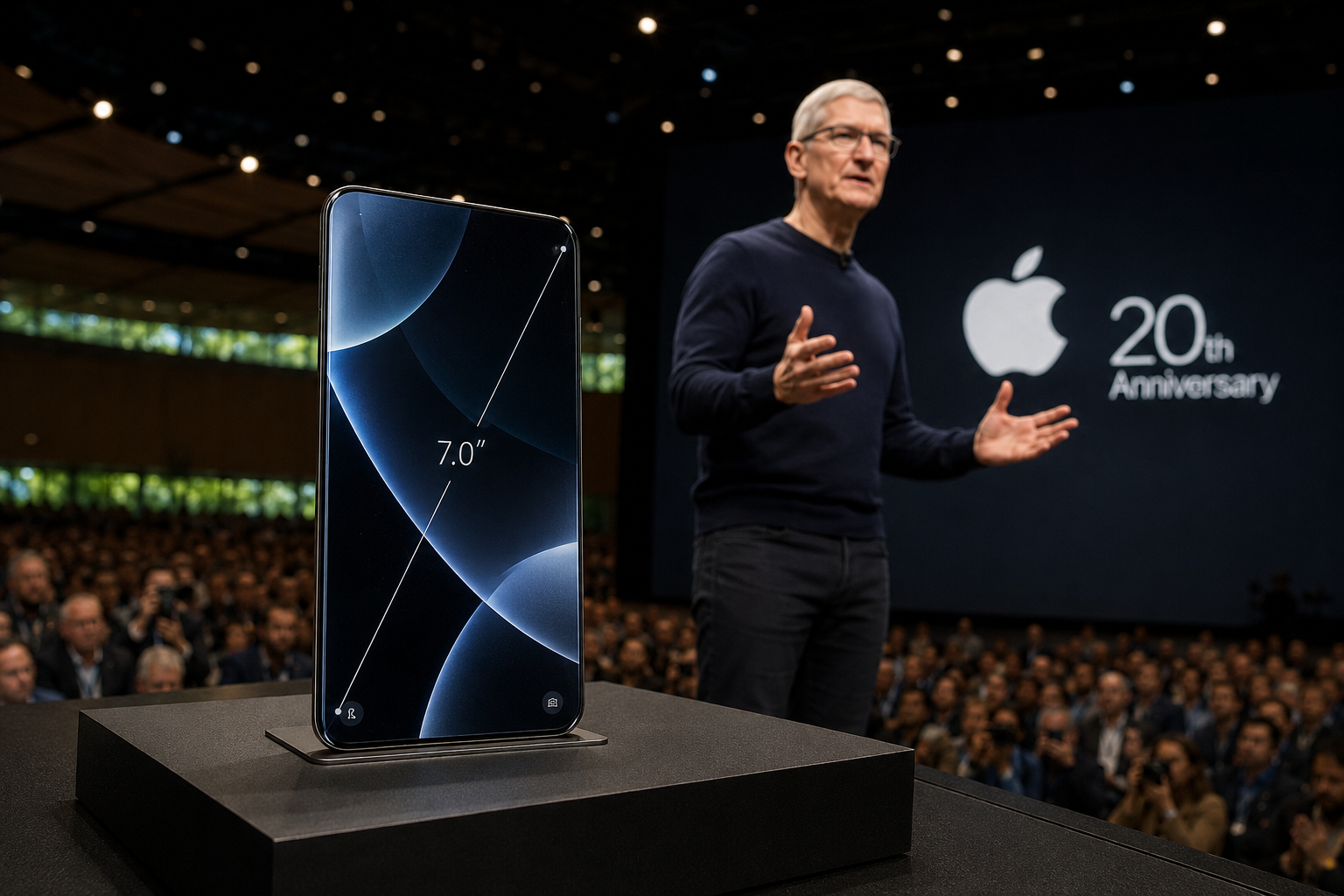
Fresh supply chain leaks confirm that Apple is internally testing a massive 6.96-inch display panel. If this screen makes it past the prototyping phase and onto the assembly line, Apple will market it as a 7-inch display for its highest-tier 20th Anniversary iPhone tentatively expected to launch in 2027.
According to reports initially surfaced by the reliable Chinese leaker Digital Chat Station and subsequently backed by Bloomberg's supply chain tracking, Apple is actively evaluating this panel for its flagship lineup. This isn't just another routine decimal-point bump. Crossing into 7-inch territory represents a psychological and physical milestone that officially erases the boundary between the smartphone and the tablet.
I want to dive deep into what this 7-inch rumor actually means, cut through the marketing fluff, look at the engineering hurdles, and evaluate whether a 7-inch iPhone is something you should actually want in your pocket.
Breaking Down the Math: Is 6.96 Inches Really That Much Bigger?
When you hear "7-inch iPhone," your immediate knee-jerk reaction might be panic about your pocket space. But we need to look at the actual mathematics of display diagonals and bezel reduction before jumping to conclusions.
The current iPhone 17 Pro Max features a 6.86-inch display (which Apple rounds up to 6.9 inches in marketing materials). Moving to a 6.96-inch panel represents a diagonal increase of roughly 0.10 inches or about a 1.5% to 2% increase in surface area.
Because Apple is maintaining the familiar 19.5:9 aspect ratio on this prototype, the display grows both slightly taller and slightly wider. However and this is the crucial detail—the physical body of the phone might barely grow at all.
Supply chain intelligence indicates that Apple is developing a quad-curved "Liquid Glass" panel in partnership with Samsung Display. By curving the glass subtly on all four edges and pushing the active pixels deeper into the perimeter, Apple can extract an extra tenth of an inch of screen real estate entirely out of the bezels.
If Apple executes this correctly, a 7-inch iPhone 20 Pro Max could sport nearly the exact same physical height and width as the iPhone 17 Pro Max. You get more immersive visual space without needing to stretch your thumbs any further than you already do.
The Ergonomic Debate: Why Curved Glass Divides the Community
While slimming down bezels sounds great on paper, wrapping display glass around the edges of a phone brings back a very familiar, polarizing debate.
If you used Android flagships during the mid-2010s specifically devices like the Samsung Galaxy S7 Edge or the Huawei Mate series you know the pain of dramatic screen curves. They looked stunning in promotional photos, but in day-to-day use, they were plagued by two massive flaws:
- Accidental Palm Touches: Typing a quick message with one hand frequently triggered ghost inputs because the base of your thumb rested on the curved display edge.
- Case Compatibility and Fragility: Protective cases either had to cut away their side lip leaving the exposed glass vulnerable to drops or cover up the curved edges, rendering the extra screen space useless.
Apple is reportedly addressing this by using what engineers call a "shallow micro-curve" rather than a steep waterfall curve. The goal isn't to wrap active touch controls around the side of the casing, but rather to give the glass a continuous, pebble-like contour where the display meets the titanium frame.
From an aesthetic standpoint, a quad-curved, borderless 7-inch sheet of glass fulfills Jony Ive’s long-standing dream: an iPhone that looks like a single, seamless piece of glass. From a practical standpoint, I am still skeptical. Dropping a $1,600 smartphone wrapped in curved glass on a concrete sidewalk is going to test the absolute limits of Apple's Ceramic Shield technology.
How We Got Here: Two Decades of Screen Inflation
To appreciate how wild a 7-inch iPhone sounds, it helps to zoom out and look at the trajectory of iPhone display sizes since the original model debuted twenty years ago.
When Steve Jobs pulled the original iPhone out of his pocket in 2007, its 3.5-inch screen was considered massive compared to the tiny 2-inch displays on contemporary BlackBerry and Nokia devices. For seven years, Apple resisted the industry trend toward larger screens, famously running TV commercials demonstrating how a human thumb could reach every corner of an iPhone 5's 4-inch display.
The dam broke in 2014 with the iPhone 6 Plus (5.5 inches), followed by the iPhone XS Max in 2018 (6.5 inches), the iPhone 12 Pro Max in 2020 (6.7 inches), and the iPhone 16/17 Pro Max lineup in 2024–2025 (6.9 inches).
What makes the 7-inch mark so fascinating is its proximity to Apple’s other product categories. The original iPad mini featured an 7.9-inch display. Today’s iPad mini sits at 8.3 inches. If the largest iPhone expands to 7.0 inches, the gap between Apple's largest phone and its smallest tablet narrows to roughly a single inch.
For users who consume hours of video, edit high-resolution photos on the go, or treat their phone as their primary computing device, a 7-inch canvas is a dream. For everyone else, it highlights a growing problem in Apple’s lineup: the disappearance of truly compact flagship phones.
Rumored Specifications: 20th Anniversary iPhone Flagship
While the 6.96-inch display is currently stealing the headlines, it is only one component of a much broader, ground-up overhaul planned for the 20th Anniversary model in 2027.
Based on verified supply chain leaks and insider reports from Bloomberg and industry analysts, here is the rumored hardware feature set for Apple’s commemorative flagship:
- Display: 6.96-inch LTPO+ OLED, 1-120Hz ProMotion, quad-curved "Liquid Glass" architecture with ultra-thin borderless bezels.
- Biometrics: Under-display Face ID sensors paired with a reduced-size punch-hole camera.
- Processor: Apple A21 Pro or A22 Pro built on TSMC's cutting-edge 1.4nm (A14) fabrication node for massive thermal and power efficiency gains.
- Buttons: Solid-state haptic volume and power buttons powered by a dedicated, ultra-low-power microprocessor that functions even when the main battery is drained.
- Chassis Construction: Single-piece polished titanium frame with seamless front and rear glass curvature.
- Camera System: Triple 48MP rear setup with a second-generation mechanical variable aperture system on the primary wide lens.
- Connectivity: Apple-designed in-house C2 5G/Satellite modem with integrated N2 Wi-Fi/Bluetooth wireless silicon.
Detailed Hardware Comparison: Evolution of the Pro Max
To understand how far Apple has pushed the physical envelope, let's compare the rumored 20th Anniversary 7-inch prototype directly against previous generations of Apple's flagship Pro Max models.
| Metric / Feature | iPhone 12 Pro Max (2020) | iPhone 15 Pro Max (2023) | iPhone 17 Pro Max (2025) | 20th Anniversary Prototype (2027 Rumored) |
| Display Size | 6.7 Inches | 6.7 Inches | 6.86 Inches (6.9") | 6.96 Inches (7.0") |
| Panel Technology | Flat Super Retina XDR | Flat Super Retina XDR | Slim-Bezel OLED | Quad-Curved "Liquid Glass" OLED |
| Bezel Width | ~3.47 mm | ~1.55 mm | ~1.15 mm | Sub-1.0 mm (Borderless Effect) |
| Chassis Material | Stainless Steel | Grade 5 Titanium | Titanium Alloy | Polished Seamless Titanium |
| Process Node | 5nm (A14 Bionic) | 3nm (A17 Pro) | 3nm Enhanced (A19 Pro) | 1.4nm (A21/A22 Pro) |
| Face ID System | Traditional Notch | Dynamic Island | Reduced Dynamic Island | Under-Display Face ID |
| Primary Camera | 12MP Sensor-Shift | 48MP (Fixed Aperture) | 48MP (Fixed Aperture) | 48MP (Variable Aperture) |
The Engineering Challenge: Why a 7-Inch Slab Is Hard to Build
Testing a 6.96-inch panel in a laboratory is one thing; mass-producing tens of millions of them with high yield rates is a completely different beast. Apple and its display partners face three major technical barriers before this screen ever sees the light of day.
1. Optical Distortion on Curved Edges
When light passes through glass that curves toward the outer frame, it bends. On previous curved phones, this created a distracting gray color shift along the left and right edges when viewing white backgrounds, as well as text distortion near the margins.
To eliminate this, Samsung Display is reportedly supplying Apple with a new polarizer-free OLED architecture. By removing the traditional polarizing layer and printing a color filter directly on the encapsulation layer, the display achieves wider viewing angles and higher peak brightness while drastically reducing edge distortion.
2. Internal Thermal Management
A bigger screen draws more power, especially when pushing high refresh rates and ultra-high brightness levels in direct sunlight. Furthermore, high-end mobile processors like the rumored 1.4nm A21/A22 Pro generate concentrated heat during intensive AI workloads and gaming.
If Apple expands the display surface area without increasing the phone's thickness, heat dissipation becomes a bottleneck. We expect Apple to integrate a vapor chamber cooling system across the main logic board a feature that Android flagships have utilized for years but Apple has hesitated to implement globally.
3. Battery Distribution and Density
Powering a nearly 7-inch display requires a massive cell. The iPhone 17 Pro Max already houses a substantial battery, but pushing into 7-inch territory demands even higher energy density. Recent code references uncovered in the iOS beta indicate Apple is experimenting with multi-cell battery architectures, potentially splitting the battery into two distinct cells connected by a high-speed power delivery bus. This allows engineers to distribute weight more evenly across a large device, preventing the phone from feeling top-heavy in your hand.
The Coexistence Strategy: Slabs vs. Foldables
We cannot analyze a 7-inch traditional iPhone without acknowledging the elephant in the room: Apple’s long-rumored foldable device.
Reports from Bloomberg and supply chain analysts suggest that by 2027, Apple’s iPhone portfolio will split into three distinct hardware tiers:
- Standard Slab iPhones: The traditional 6.3-inch and 6.9/7.0-inch form factors for users who want maximum reliability, traditional durability, and top-tier camera hardware.
- Ultra-Thin Air Series: Focused entirely on minimal weight and ultra-sleek profiles, sacrificing battery capacity and camera count for pure portability.
- The Foldable Lineup (iPhone Ultra / Fold): A passport-style book-fold device featuring a ~5.4-inch outer cover screen that opens up into an expansive 7.7-inch inner display.
This multi-pronged strategy makes total sense. A 7-inch rigid slab phone isn't meant to compete with a foldable; it exists for users who explicitly do not want a folding mechanism.
Foldable phones, despite rapid improvements in hinge durability and crease reduction, still require compromises. They are thicker when closed, carry lower water/dust resistance ratings, and cannot accommodate the thickest, highest-quality camera sensors due to depth constraints.
A 7-inch rigid iPhone 20 Pro Max gives power users the absolute maximum screen size possible without introducing moving mechanical parts, hinges, or soft plastic inner screens.
Have We Reached Peak Phone?
I have covered mobile technology for well over a decade, and if there is one lesson history teaches us, it is that consumers almost always adapt to larger screens faster than they think they will.
When the iPhone 6 Plus launched in 2014, people swore they would never buy a 5.5-inch phone. Within two years, it was Apple's best-selling configuration. When the screen grew to 6.7 inches with the iPhone 12 Pro Max, critics insisted we had reached the absolute human limit. Yet today, the Pro Max remains Apple's highest-margin, most popular individual model worldwide.
However, pushing to 6.96 inches touches a very real physical boundary. Our hands are not getting any bigger. Jean pockets are not getting any deeper.
If Apple can achieve this 7-inch milestone primarily through bezel reduction and quad-curved glass sculpting keeping the physical footprint virtually identical to today's 6.86-inch iPhone 17 Pro Max then it will be a triumph of modern industrial design. You get more immersive video playback, a roomier keyboard for typing, and extra space for complex multi-window workflows without paying a penalty in portability.
On the other hand, if this screen increase results in a heavier, wider, or more awkward brick that requires two hands just to navigate the lock screen, Apple risks alienating even its most devoted power users.
The fact that Apple is actively prototyping a 6.96-inch panel proves that the company isn't content resting on its laurels for the iPhone's 20th anniversary. They are testing the absolute limits of glass, silicon, and human ergonomics. Whether this 7-inch panel makes it to the final production line in 2027 or gets shelved in favor of a slightly more conservative design, one thing is abundantly clear: the era of the small flagship phone is officially behind us, and the boundary between phone and tablet has never been thinner.