

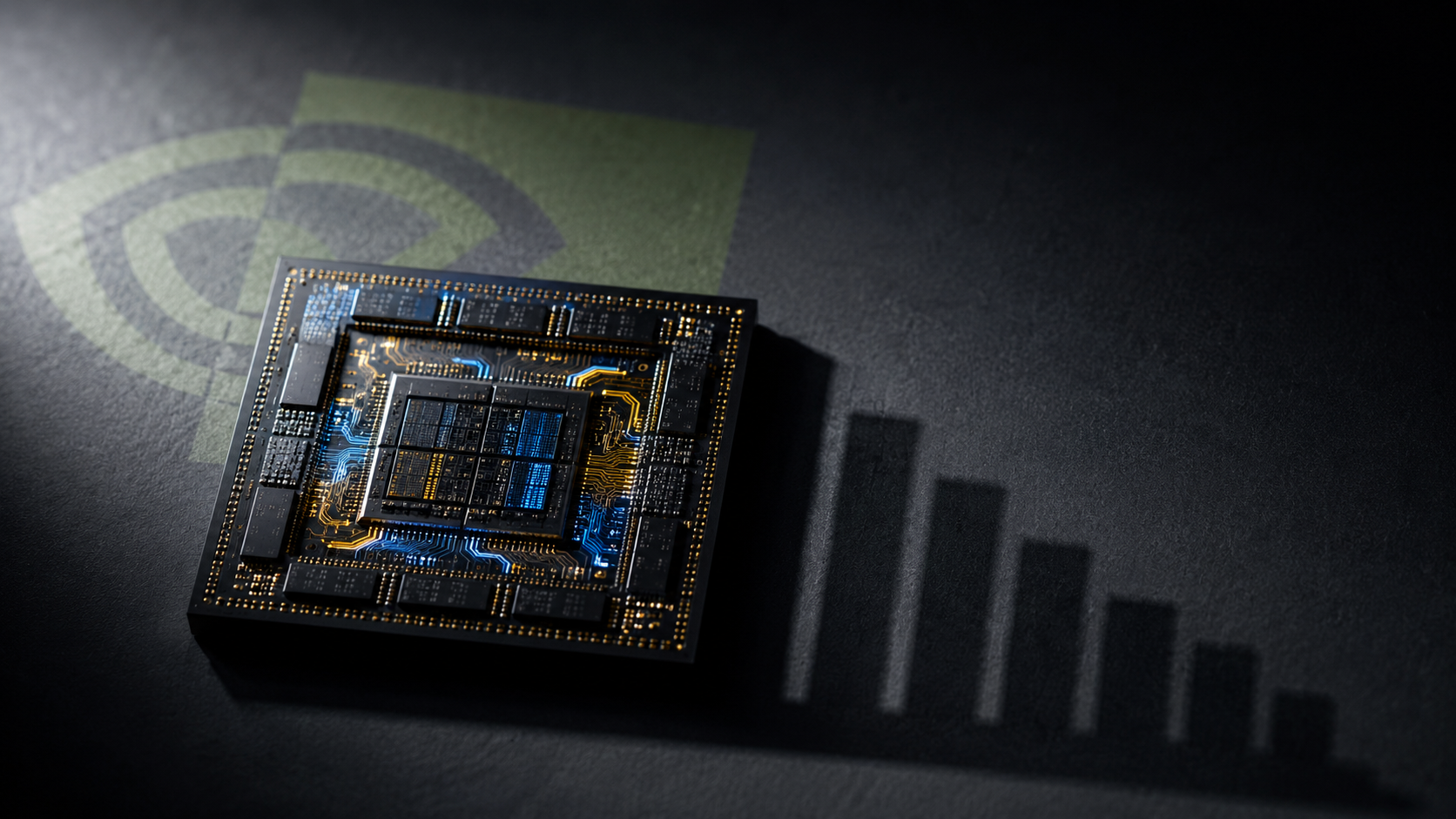
On May 20, 2026, Nvidia did what it always does: it obliterated expectations, rewrote the record books, and proved that the global buildout of artificial intelligence infrastructure is the largest capital expenditure wave in modern human history. The company reported a mind-boggling $81.62 billion in revenue for the first quarter of fiscal 2027, representing an 85.2% explosion year-over-year. Profits followed a similar vertical trajectory, with non-GAAP earnings per share landing at $1.87, easily clear of the $1.77 consensus Wall Street had penciled in.
To sweeten the deal for traditional value investors who still view tech with a cynical eye, Nvidia’s board authorized a massive 25-fold increase in its quarterly dividend—from a mere penny to $0.25 per share—and tossed a fresh $80 billion stock buyback program onto the pile.
And how did the stock market reward this near-flawless corporate performance? By dropping the share price by roughly 1.5% in after-hours trading.
To the casual observer, this looks like absolute madness. How does a company beat revenue expectations by nearly $3 billion, guide the next quarter billions above consensus, and still watch its stock tick downward? As someone who has tracked the semiconductor sector through multiple cyclical peaks and valleys, I see this not as a sign of Nvidia’s weakness, but as a clinical case of market exhaustion. The bar for Nvidia is no longer just "good" or even "excellent." The bar has been raised to an impossible level where anything short of a supernatural guidance beat triggers immediate profit-taking.
Let's look past the raw hype and analyze the deep structural realities of Nvidia’s latest print, the technical execution risks hidden in their hardware pipeline, and why the market is suddenly acting so terrified of a company that is essentially minting its own currency.
Deconstructing the Numbers: The Infrastructure Supercycle is Real
To understand why investors are reacting with relative restraint, we first need to look at what Nvidia actually delivered. The numbers are not just large; they are historically unprecedented for a hardware company operating at this scale.
Data Center Dominance and the Networking Explosion
The core of the Nvidia thesis lives and dies in the data center. For Q1 FY2027, data center revenue reached a record $75.2 billion, up 92% from a year earlier. If you isolate the compute revenue alone, it grew 77% year-over-year to $60.4 billion, driven by the insatiable appetite for cluster architectures to power generative AI.
However, the real shocker—and a number that many retail investors completely gloss over—is the networking segment. Data center networking, which includes InfiniBand and the increasingly vital Spectrum-X Ethernet platform, brought in $14.8 billion. That is a jaw-dropping 199% increase year-over-year.
This networking surge tells us something critical about the state of AI deployment in 2026. AI systems are no longer about dropping a single ultra-fast chip into a server box. Modern large language models (LLMs) and agentic workflows require tens of thousands of GPUs to act as a singular, unified brain. Networking is the plumbing that keeps the system from choking on its own data transfer speeds. Without Nvidia’s NVLink and Spectrum-X setups, the chips themselves sit idle, waiting for data. Nvidia isn't just selling the engines anymore; they own the entire highway system.
Financial Summary: Q1 FY2027 vs. Q1 FY2026
To contextualize the scale of this growth, look at how the core financial lines shifted over a 12-month window:
| Financial Metric | Q1 FY2027 (Actual) | Q1 FY2026 (Prior Year) | Year-over-Year Change |
| Total Revenue | $81.62 Billion | $44.10 Billion | +85.2% |
| Data Center Revenue | $75.20 Billion | $39.10 Billion | +92.3% |
| Networking Revenue | $14.80 Billion | $4.95 Billion | +199.0% |
| Non-GAAP Gross Margin | 75.0% | 60.8% | +14.2 percentage points |
| Non-GAAP EPS | $1.87 | $0.78 | +139.7% |
| Q2 Revenue Guidance | $91.00 Billion (±2%) | $46.70 Billion | +94.8% (at midpoint) |
The Structural Shift: Hyperscale vs. The Rise of Sovereign AI
For quarters, the bear case against Nvidia was built on the "concentration risk" argument. Skeptics warned that if a handful of massive US tech companies—namely Microsoft, Alphabet, Meta, and Amazon—ever decided to cool their capital expenditures, Nvidia’s revenue would drop off a cliff.
The Q1 FY2027 earnings call shattered that neat little narrative, revealing a deep, structural 50-50 split within the data center business that changes everything:
- Hyperscalers: Cloud giants accounted for roughly $37.9 billion of data center revenue. These companies are building out massive public cloud infrastructures to lease compute power to enterprises and developers.
- ACIE (AI Clouds, Industrial, Enterprise, and Sovereign AI): This segment pulled in an astonishing $37.4 billion.
This near-equal split is the most bullish detail in the entire report, yet the market largely ignored it. Sovereign AI—nations like Japan, France, Singapore, and various Middle Eastern states building domestic data centers to preserve linguistic and cultural data ownership—is transitioning from a policy concept into a massive revenue engine. When a nation-state decides it needs independent computing power, its budget isn't governed by corporate quarterly ROI metrics; it is governed by national security and economic survival.
Furthermore, enterprise spending is moving beyond simple chatbot experimentation. CEO Jensen Huang heavily emphasized the arrival of "Agentic AI"—multi-agent AI systems that execute complex, multi-step corporate workflows autonomously. These agentic models require continuous, high-throughput inference infrastructure, meaning that even after a model is trained, the cost to keep it running (inference) keeps feeding Nvidia's top line.
The Hardware Transition: The Blackwell to Rubin Tightrope
If the financial metrics and demand drivers are so healthy, why did the stock slip? The answer lies in the engineering timelines and the terrifyingly fast cadence of Nvidia's product rollouts.
Wall Street is hyper-focused on the handoff between Nvidia’s current-generation Blackwell architecture and the newly unveiled Vera-Rubin platform, which is slated to begin ramping up in the second half of calendar 2026 and into 2027.
The Risk of an "Air Pocket" in Demand
In traditional tech hardware cycles, announcing a revolutionary new product while your current product is still flying off shelves is a recipe for disaster. It creates what analysts call an "air pocket"—a temporary demand vacuum where customers cancel or pause orders for the current architecture (Blackwell) because they want to save their capital for the next shiny object (Rubin).
Nvidia is attempting to break the traditional laws of tech lifecycles by shifting from a two-year product cadence to an aggressive annual release schedule. While this keeps rivals like AMD and Intel permanently playing catch-up, it introduces intense execution risk. If there is even a minor manufacturing delay at TSMC (Taiwan Semiconductor Manufacturing Company) with the advanced packaging required for the Rubin platform, or if hyperscalers blink and decide to wait six months for Rubin instead of deploying Blackwell clusters today, Nvidia's sequential growth numbers could flatten out. For a stock priced for absolute perfection, a flat quarter feels like a catastrophic crash to momentum investors.
Technical Comparison: Architectural Evolution
To see why customers are tempted to wait, we have to look at the immense leaps in hardware specifications across Nvidia's three most recent platform eras:
- Hopper Architecture (H100 / H200)
- Process Node: TSMC 4N (Custom 5nm)
- Memory Type: HBM3 / HBM3e
- Max Memory Capacity: Up to 141GB (H200)
- Core Focus: Foundational training for Early LLMs
- Interconnect Speed: 900 GB/s NVLink
- Blackwell Architecture (B200 / GB200)
- Process Node: TSMC 4NP (Optimized 5nm) Dual-Die
- Memory Type: HBM3e
- Max Memory Capacity: Up to 384GB (GB200 NVL72)
- Core Focus: Massive scale training and 10x throughput per megawatt improvement in inference workloads over Hopper
- Interconnect Speed: 1.8 TB/s NVLink 5
- Vera-Rubin Architecture (R100)
- Process Node: TSMC 3nm (N3X or equivalent)
- Memory Type: Next-generation HBM4
- Max Memory Capacity: Estimated greater than 500GB per node
- Core Focus: Native Multi-Agent Orchestration, ultra-low latency inference, and unified algorithmic logic
- Interconnect Speed: Next-generation high-bandwidth switching fabrics
When you look at those specifications, the leap from Hopper to Blackwell was massive, but the impending shift to Rubin—bringing HBM4 memory architecture to the table—is a quantum jump. Investors are terrified that Nvidia has built a product line so compelling that it might accidentally cannibalize its own short-term revenues.
Geopolitical Friction: The Zero-China Outlook
Beyond the hardware transition, the second major factor dampening market enthusiasm is the geopolitical wall that Nvidia is actively hitting. In the Q1 FY2027 guidance, management explicitly stated that they are assuming zero data center compute revenue from China in their forward outlook.
This is a stark reality check. For years, China represented up to 20% to 25% of Nvidia’s total addressable market. Following strict US export controls, Nvidia attempted to salvage this footprint by engineering watered-down, compliant chips like the H200-derivative lines for the Chinese market. However, recent macro developments have effectively frozen that bridge:
- Summit Disappointments: The recent Trump-Xi summit concluded without any major breakthroughs or concessions on semiconductor trade, meaning the current strict export bans remain firmly entrenched.
- Domestic Substitutes: Facing perpetual uncertainty over US policy, Chinese tech giants (like Alibaba, Tencent, and Baidu) are aggressively pivoting away from western hardware altogether, opting to pour capital into domestic alternatives like Huawei’s Ascend lineup.
The fact that Nvidia can guide for $91 billion in Q2 revenue while completely writing off the Chinese market is a testament to how insanely strong demand is in the rest of the world. But from an institutional investor's point of view, losing a major geographical engine permanently caps the long-term upside. It means Nvidia is now completely dependent on Western hyperscalers and sovereign entities keeping their foot on the gas.
The Macro Picture: High Yields vs. Tech Multiples
We cannot analyze Nvidia in a vacuum; the broader stock market is facing severe structural headwinds that make institutional money managers deeply hesitant to bid high-multiple growth stocks any higher.
During the week of Nvidia's earnings print, the 30-year US Treasury yield surged to a 19-year high of 5.19%. When risk-free government bonds are yielding over 5%, the math governing equity valuations changes dramatically. Investors require a much higher equity risk premium to hold stocks, especially those trading at premium forward price-to-earnings ratios.
When you compound elevated bond yields with persistent geopolitical anxieties, capital inevitably rotates out of high-flying momentum stocks and into defensive positions. Nvidia didn't drop because its business is broken; it dropped because the macro-environment is forcing a de-risking process across the entire tech sector.
Why the Muted Reaction is Actually Healthy
In my view, this post-earnings dip is the healthiest thing that could happen to Nvidia and the broader AI ecosystem. The "beat-and-sell" pattern we are observing is a sign that the market is finally separating emotional hype from cold, hard capital discipline.
For the past three years, the AI trade was entirely speculative, driven by flashy chatbot demonstrations and vague corporate promises of future productivity gains. Today, in mid-2026, we have firmly entered the infrastructure reality phase. Investors are no longer asking if the demand is real—an $81.6 billion quarter answers that definitively. Instead, they are asking the much harder, more mature questions:
- What is the long-term return on invested capital (ROIC) for the companies buying these chips?
- Can corporate margins withstand an annual hardware upgrade cycle?
- How long can gross margins stay parked at a historical 75% before competitive chip pricing or custom silicon (like Google’s TPUs or Amazon’s Trainium) forces a regression to the mean?
Nvidia remains the undisputed kingpin of the modern computing landscape. It has successfully evolved from a graphics card company into an enterprise AI computing platform provider, spanning silicon, networking hardware, and specialized software layers. A minor 1.5% fluctuations in after-hours trading is merely short-term noise. The real story is that Nvidia has laid down a $91 billion gauntlet for the upcoming quarter, proving that the physical construction of the AI era isn't slowing down—even if Wall Street needs a moment to catch its breath.
For a deeper dive into how financial analysts and industry experts view the shifting dynamics of the AI infrastructure rollout, you can check out this comprehensive breakdown on the market's response:
The Key Takeaways From Nvidia's Earnings and Forecast
This video provides an excellent summary of the direct economic impacts of the latest guidance figures, detailing how big tech capital expenditures are directly translating into real-world server deployment and why the initial market reaction was so unusually restrained.