

The tech community has spent the better part of three years repeating a single, hopeful phrase like a mantra: "Just wait until Google moves to TSMC." For anyone who has carried a Pixel 7, 8, or 9 as a daily driver, the frustrations have always been identical. We love the clean Android interface, we swear by the uncanny computational photography, but we quietly tolerate the fact that the phones run hot in summer, drop cellular signals in crowded areas, and trail generations behind Apple and Qualcomm in pure, raw hardware power.
Now, deep into 2026, the massive, highly detailed supply chain leaks regarding the upcoming Google Pixel 11 Pro lineup internally codenamed Grizzly have officially landed. The good news? The rumors are true. Google is completely severing its hardware manufacturing ties with Samsung Foundry and shifting the entire execution of its upcoming Tensor G6 chipset to TSMC’s cutting-edge 2nm (N2) manufacturing process.
But if you think this move automatically transforms the Pixel 11 Pro into a benchmark-shattering monster that will leave the upcoming iPhone 18 Pro or Galaxy S26 Ultra in the dust, you need a heavy dose of reality. The deep structural specifications leaked this month reveal a device that is a fascinating, frustrating masterclass in engineering compromise. Google is fixing its biggest historical flaws while simultaneously making a puzzling graphical hardware choice that will alienate mobile gamers.
Let's dismantle the hype and look at the raw numbers, the verified hardware adjustments, and what it actually feels like to watch Google navigate its most critical hardware pivot in a half-decade.
The TSMC N2 Migration: Splitting the CPU Architecture Wide Open
The headline feature of the Tensor G6 is undoubtedly its migration to TSMC's 2nm node. Moving down to a 2nm topology means transistors are packed closer together than ever before, promising a massive leap in power efficiency and thermal regulation. For a phone series that has historically throttled its performance just from recording 4K video on a sunny day, this is a massive victory.
However, the internal layout of the Tensor G6 CPU is highly unorthodox. Rather than following the conventional 8-core design utilized by almost every flagship processor in 2026, Google has engineered a custom 7-core CPU configuration.
According to leaked architecture documents, the processor breaks down into three distinct clusters:
- 1x ARM Cortex C1-Ultra Prime Core: Clocked at an incredibly fast 4.11 GHz. This single core is designed to handle heavy, instantaneous single-threaded bursts, like launching a massive application or executing an complex on-device generative AI model.
- 4x ARM Cortex C1-Pro Performance Cores: Running at 3.38 GHz. These handle the heavy lifting of multi-tasking, background system indexing, and active application processing.
- 2x ARM Cortex C1-Pro Efficiency Cores: Running at 2.65 GHz. These low-power cores take over during idle states, music playback, or basic text messaging, keeping battery consumption to an absolute minimum.
My take on this layout? It is a highly intelligent piece of real-world engineering. By dropping an efficiency core and beefing up the clock speeds on the Pro cores, Google is trying to bridge the massive single-core performance gap that has allowed Apple to dominate the U.S. market for years.
Going from an aging architecture to the latest Cortex designs on a 2nm node should result in an estimated 20% to 25% jump in battery life expectancy, giving the Pixel 11 Pro a projected screen-on time that might finally cross the elusive 8-hour threshold under normal daily use.
The PowerVR Trap: The Big Catch in the Tensor G6 Graphics
Here is where the optimism hits a wall. While the CPU side of the Tensor G6 looks modern and highly efficient, the leaked GPU configuration is causing widespread bewilderment among hardware enthusiasts.
Google is reportedly equipping the Tensor G6 with a PowerVR C-Series CXTP-48-1536 GPU. If that architecture sounds vaguely familiar, that is because it is based on a foundational graphics design first introduced by Imagination Technologies back in 2021.
The Graphical Disconnect: While Qualcomm is shipping the Snapdragon 8 Elite Gen 6 with hardware-accelerated ray tracing and desktop-class graphics pipelines, Google is choosing a GPU foundation that is half a decade old.
Why would Google pair a cutting-edge 2nm CPU node with a legacy GPU architecture? The answer comes down to cost and corporate focus. Google's senior hardware team has stated repeatedly over the last two years that they do not care about breaking benchmark records or appealing to hardcore mobile gamers. Their entire silicon budget is funneled directly into their custom Tensor Processing Unit (TPU) for on-device machine learning and their new "Metis" Image Signal Processor (ISP).
If you are someone who plays graphically intense titles like Genshin Impact or high-frame-rate competitive shooters at maximum settings, the Pixel 11 Pro is going to disappoint you. The node shrink to 2nm means the GPU will run incredibly cool and won't throttle under sustained load, but its absolute performance ceiling will likely be lower than what Samsung and Apple shipped a year ago. It’s a deliberate choice by Google: sacrificing high-end mobile gaming to fund advanced AI capabilities.
Ditching Samsung Modems: The Best Upgrade Nobody Is Talking About
While the GPU choice will cause endless arguments on tech forums, daily users should celebrate a different, crucial component swap: the cellular modem.
For generations, Pixels have relied on Samsung Exynos modems. It was the root cause of the phone’s most annoying real-world flaws sluggish handoffs between Wi-Fi and 5G, random dropped calls in structural dead zones, and massive battery drain whenever you left your home Wi-Fi network.
The Pixel 11 Pro series is officially waving goodbye to Samsung's radio frequency division. Instead, the Tensor G6 is being paired with a custom MediaTek M90 modem (MT6986D).
MediaTek has quietly become an industry leader in highly efficient, low-power cellular connectivity. The M90 modem brings fully integrated support for 3GPP Release 17 and Release 18 standards, meaning faster sub-6GHz 5G data retention, vastly improved thermal performance when acting as a mobile hotspot, and native support for true satellite-based emergency communication via Google’s ongoing carrier partnerships. From a practical usability standpoint, this single component swap is more valuable than any minor CPU clock speed boost.
Technical Specifications: The Leaked 2026 Pixel 11 Pro Lineup
To see how Google is structuring its hardware tiers across the entire family later this year, look at the concrete specification breakdown leaked from internal product registries:
| Feature / Hardware Element | Google Pixel 11 (Standard) | Google Pixel 11 Pro (Compact Flagship) | Google Pixel 11 Pro XL (Max Flagship) |
| Internal Codename | Cubs | Grizzly | Kodiak |
| Display Panel | 6.3-inch Samsung M16 OLED | 6.3-inch Samsung M16 LTPO | 6.8-inch Samsung M16 LTPO |
| Resolution Metrics | 1080 x 2424 pixels | 1280 x 2856 pixels | 1344 x 2992 pixels |
| Peak Brightness | 2,200 nits | 2,450 nits | 2,450 nits |
| PWM Frequency | 240Hz | 240Hz | 240Hz |
| RAM Array | 8GB / 12GB LPDDR5X | 12GB / 16GB LPDDR5X | 12GB / 16GB LPDDR5X |
| Onboard Storage | 128GB / 256GB (UFS 4.0) | 256GB / 512GB / 1TB | 256GB / 512GB / 1TB |
| Primary Camera | 50MP Wide (Custom Sensor) | 50MP Wide (New Generation) | 50MP Wide (New Generation) |
| Telephoto Lens | None (Digital Zoom Only) | 48MP Sony IMX858 (5x Optic) | 48MP Sony IMX858 (5x Optic) |
| Ultra-Wide Lens | 12MP Ultra-Wide | 48MP Ultra-Wide (Macro) | 48MP Ultra-Wide (Macro) |
| Typical Battery | 5,000 mAh | 4,850 mAh | 5,200 mAh |
| Wired Power Intake | 25W Fast Charging | 30W Fast Charging | 45W Fast Charging |
Display Brilliance: Beating Apple to the Samsung M16 Panel
If there is one area where Google is absolutely refusing to compromise, it is the display glass. The Pixel 11 Pro and Pro XL are slated to feature Samsung Display’s top-tier M16 OLED panel material set.
This is a major corporate coup for Google. Historically, Apple gets first dibs on Samsung's absolute latest, most efficient display substrates for the iPhone lineup, leaving competitors to use previous-generation hardware. This time, the Pixel 11 Pro series will hit the market utilizing the M16 panel before the iPhone 18 Pro series can deploy it.
The real-world benefit of the M16 generation isn't just the retina-searing 2,450 nits of peak brightness; it is the radical improvement to display power management. The material set allows the screen to maintain high visibility in direct sunlight while drawing significantly less power than the older panels found on current flagships.
Additionally, Google is finally addressing eye-strain concerns by implementing a 240Hz Pulse-Width Modulation (PWM) frequency. For users who are sensitive to screen flickering in dark environments, this higher frequency will make reading or watching video at night infinitely more comfortable.
Out with the Thermometer, In with "Pixel Glow"
Let's look at the external hardware design, because Google is correcting a glaring past mistake. The infrared skin-temperature sensor that sat awkwardly beneath the flash assembly on the Pixel 8 Pro through 10 Pro is officially being retired. It was a classic example of a feature nobody asked for, which quickly devolved into a useless gimmick that most users completely forgot existed.
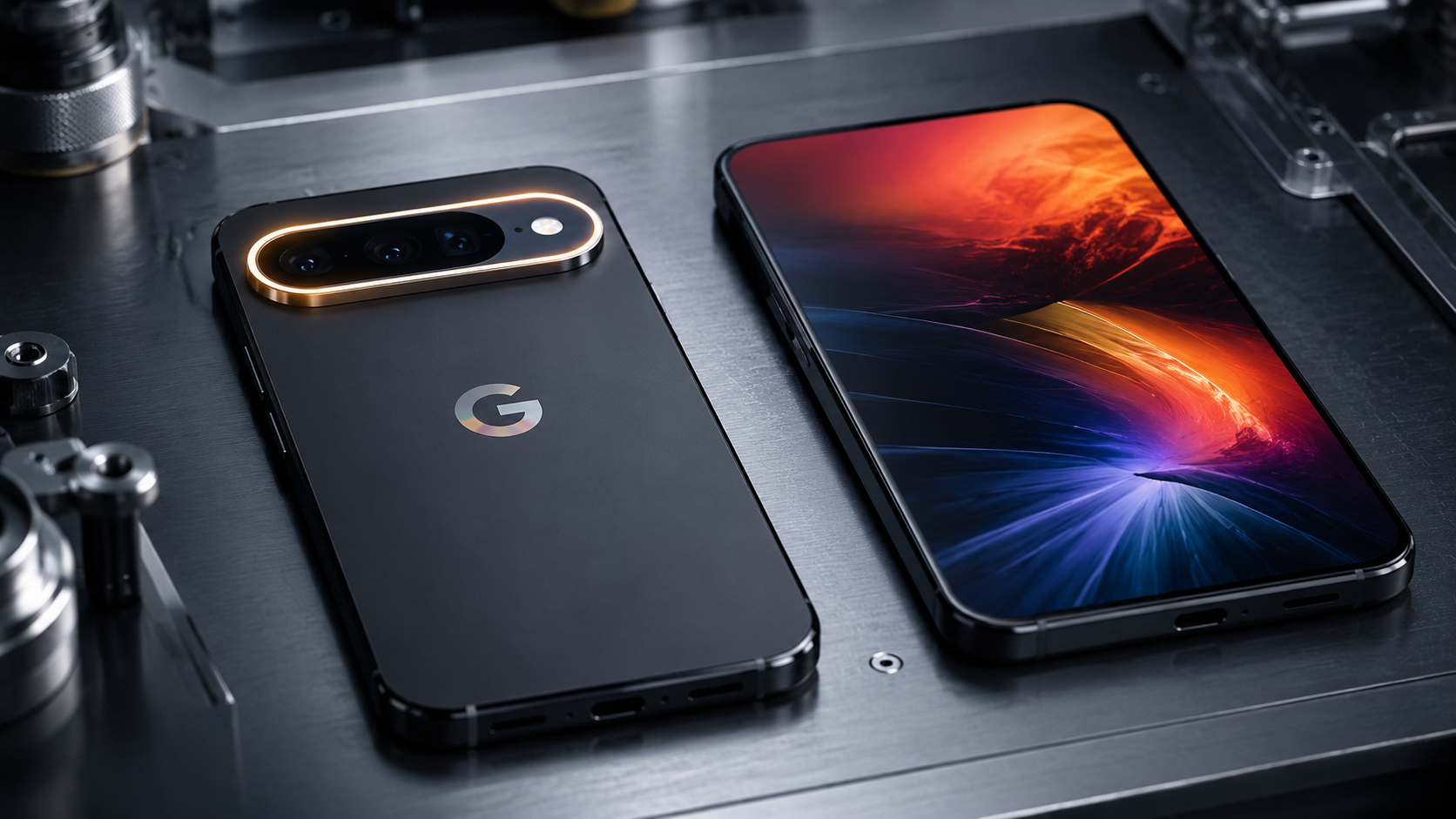
In its place on the redesigned, slightly slimmer camera visor, Google is introducing a hardware module called Pixel Glow.
Pixel Glow is an integrated 8-LED multi-colored customizable notification array built straight into the camera bar glass. If it sounds familiar, that is because it pulls heavy inspiration from the Glyph interface popularized by Nothing. However, Google’s implementation is significantly more integrated and subtle.
When your Pixel 11 Pro is sitting face-down on a conference table or desk, the Pixel Glow array can pulse in distinct, user-assigned color combinations. You can color-code your notifications so that an urgent text from your spouse pulses a gentle amber, an incoming Slack notification flashes a deep purple, and a food delivery arrival blinks green.
Furthermore, supply chain whispers suggest that Google’s onboard Gemini Intelligence is baked into the feature, allowing the light array to dynamically pulse with varied intensities depending on the contextual urgency of an incoming notification. It’s a playful, genuinely useful addition that brings some much-needed personality back to the smartphone hardware landscape.
Biometrics and the Face Unlock Dilemma
For anyone holding out hope that the Pixel 11 Pro would introduce a dedicated, secure infrared hardware face-unlock system similar to Apple’s Face ID notch, prepare for disappointment. Leaked internal testing parameters confirm that an advanced IR hardware array will not be included on the 2026 Pixels.
The engineering reality is that Google’s software team feels its current execution of Class 3 biometrics, which combines a standard high-resolution front-facing camera with deep machine-learning face matching is already secure enough to authorize high-level banking apps and password managers.
To keep the display entirely clean and borderless with a minimalist single punch-hole cutout, Google is sticking with its premium ultrasonic in-display fingerprint sensor as the primary biometric gatekeeper, backed up by the software-driven front camera face matching. It’s a practical choice that keeps the front of the device looking incredibly modern, even if it lacks the raw physical mapping security of a dedicated dot projector.
The Cross-Market Showdown: How the Competitors Compare
To understand where your money is actually going if you decide to buy a flagship device later this year, let's look at how the rumored Pixel 11 Pro coordinates against its direct architectural rivals:
| Architectural Pillar | Google Pixel 11 Pro (2026) | Apple iPhone 18 Pro (Upcoming) | Samsung Galaxy S26 Ultra |
| Chipset Node | Tensor G6 (TSMC 2nm N2) | A20 Pro (TSMC 2nm Architecture) | Snapdragon 8 Elite Gen 6 |
| CPU Core Split | Custom 7-Core Structure | Next-Gen 6-Core Layout | Custom 8-Core Oryon v3 |
| GPU Generation | PowerVR C-Series (Legacy Basis) | Custom 6-Core Apple GPU | Adreno 840 (Ray Tracing Focus) |
| Cellular Modem | MediaTek M90 (High Efficiency) | Qualcomm Snapdragon X85/Custom | Qualcomm Snapdragon X85 |
| Display Matrix | Samsung M16 LTPO OLED | Samsung M16 Display Set | Custom Dynamic AMOLED 3X |
| Notification Array | 8-LED Custom "Pixel Glow" | Always-On Software Screen | Always-On Software Screen |
| OS Version | Android 17 (Pure Google) | iOS 20 | Android 16 with One UI 8.1 |
The Human Assessment: Should You Buy In or Skip the Generation?
Looking at the full picture of the Pixel 11 Pro leaks, it is easy to fall into the trap of looking at the underpowered GPU and calling the phone a disappointment. If you evaluate smartphones purely by looking at benchmark bars on a chart, Google’s hardware strategy will continue to frustrate you.
But if you look at how we actually use our devices on a daily basis, the Pixel 11 Pro is shaping up to be the most refined, stable, and genuinely pleasant smartphone Google has ever built. By addressing its historic manufacturing pain points moving to TSMC’s incredibly cool-running 2nm node and swapping out the problematic Exynos modems for MediaTek's ultra-efficient M90 radio architecture , Google is effectively curing the thermal and connectivity issues that have haunted the brand for five long years.
The Pixel 11 Pro isn't designed to be a handheld gaming console. It is built to be an incredibly smart, highly reliable daily tool that leverages the best display panel on the market, class-leading computational photography via the new Metis ISP, and a fun, useful hardware identity with the Pixel Glow array.
If you are currently carrying an older Pixel 7 Pro or an 8 Pro and have grown tired of your phone turning into a pocket-heater during summer road trips, the Pixel 11 Pro represents the definitive, stable hardware upgrade you have been waiting for. Just don't expect it to run desktop-class video games at 120 frames per second—and honestly, for the vast majority of us, that is a compromise completely worth making.