

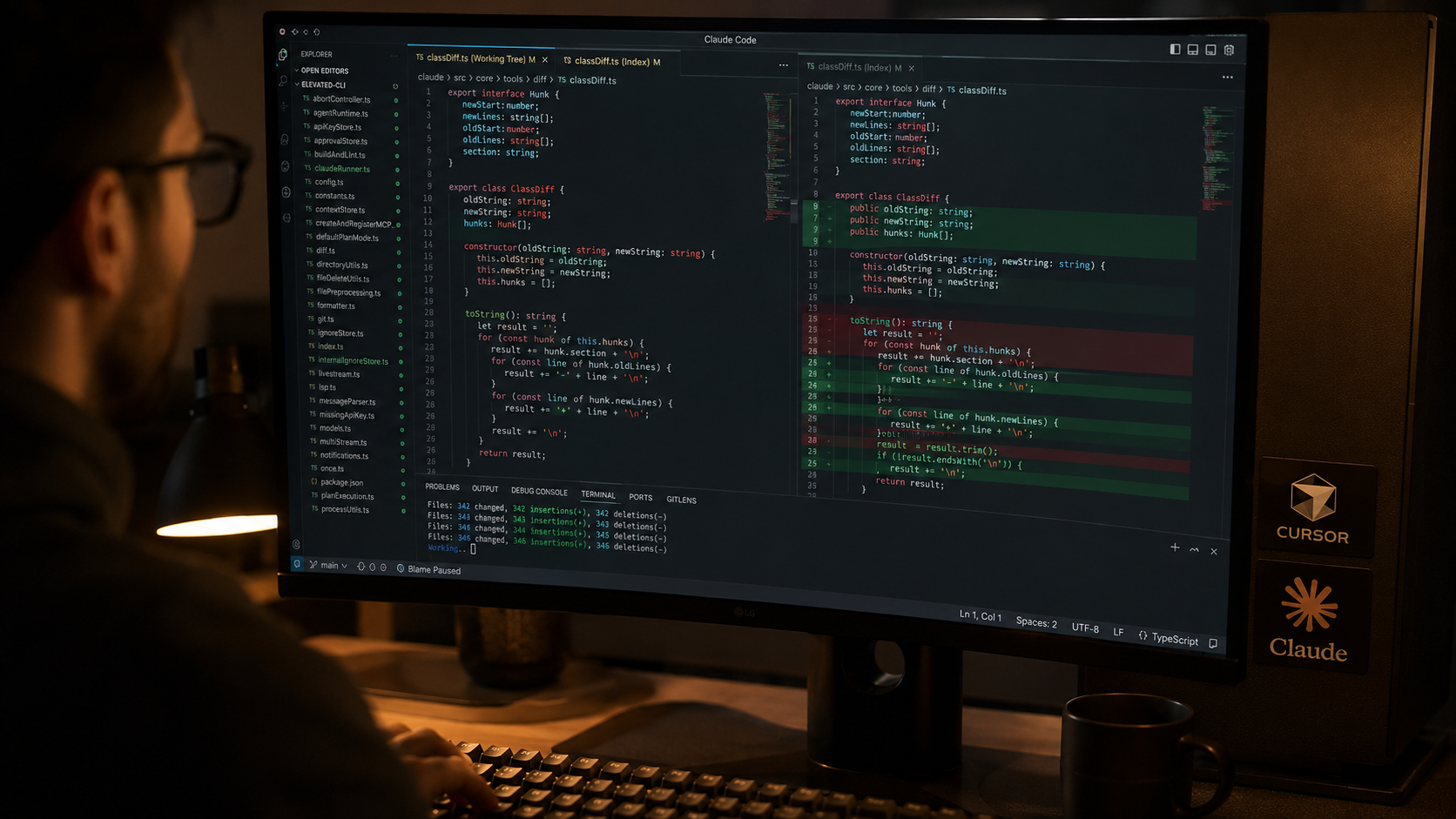
If you step onto a software engineering floor today, in June of 2026, the quiet clicking of mechanical keyboards has mostly faded. It has been replaced by a stranger, almost eerie silence, punctuated by developers staring intensely at terminals while agentic terminal workflows execute hundreds of file changes per minute.
According to recent GitHub data, nearly 46% of all production code across active repositories is now directly authored by artificial intelligence. In legacy languages like Java, that number spikes all the way to 61%. We are no longer living in the era of simple inline auto-complete or clever regex suggestions. The romantic era of the solo "code artisan" hand-crafting every loops and switch statement is dead.
The industry has collectively embraced a polarized, fascinating phenomenon known as "vibe coding." You describe the high-level system requirements, state your architectural goals in plain English, and watch an orchestrated fleet of specialized AI agents write the tests, build the backend, wire up the frontend, and open the pull request while you sip your coffee.
But let's drop the corporate tech-evangelist hype. As an engineer who has lived through this transition, I can tell you that the reality on the ground is far messier than the polished product demos suggest. While development velocity has surged by over 50%, we are simultaneously drowning in a sea of technical debt, architectural drift, and subtle security vulnerabilities that are completely slipping past junior developers who have forgotten or never learned how to read the code they are deploying.
Coding in 2026 isn't dead. But the nature of what it means to be a programmer has undergone a violent, permanent mutation.
From Copilots to Autonomous Operators: The 2026 Tooling Landscape
To understand why the developer workflow feels so fundamentally different this year, we have to look at the massive shift in our development environments. In 2024 and 2025, tools like GitHub Copilot and early iterations of Cursor were reactive. They waited for your cursor to pause, or they waited for you to highlight a block of text and ask a question.
In 2026, the market has split into three highly distinct, fiercely competitive categories, moving away from simple autocomplete toward long-running, autonomous execution.
- The Proactive Agent IDE (e.g., Cursor, Windsurf): These platforms operate via "Composer" models. Instead of suggesting the next line of code, you instruct the IDE to "refactor the entire authentication state to use a new cookie-based strategy across six files." It scans the directory, writes the diffs across multiple files simultaneously, runs a local test suite to ensure nothing broke, and presents you with a clean visual diff to approve.
- The Terminal-Native Agent (e.g., Claude Code, Gemini CLI): Operating purely within the command line interface (CLI) using Model Context Protocols (MCP), these tools possess full system access. They read the repository, execute shell commands, install missing dependencies, interpret stack traces, and iteratively debug their own errors without a graphical interface.
- The Autonomous Cloud Engineer (e.g., Devin by Cognition, GitHub Cloud Agents): This is the most disruptive tier. These are not pair programmers; they are digital contract workers. You assign a GitHub issue directly to a cloud agent. The agent spins up its own isolated virtual machine, explores the codebase, builds out the feature over hours or days, manages its own internal failures, runs containerized end-to-end tests, and pings you on Slack only when a human checkpoint or code review is required.
The 2026 AI Developer Tool Matrix
To cut through the marketing jargon, let's look at how the leading AI execution models stack up against each other in real-world engineering environments this year:
| Tool / Agent | Primary Interface | Best Suited For | Core Strength | Major Structural Limitation |
| GitHub Copilot (Agent HQ) | IDE Extension & Cloud | Scaffolding & Boilerplate | Deep integration with GitHub CI/CD | Fails on complex, multi-layered refactors |
| Cursor (Composer Mode) | Custom VS Code Fork | Rapid UI/UX & Feature Building | Exceptional multi-file visual diffing | Forces you into their proprietary IDE ecosystem |
| Claude Code | Terminal / CLI Native | Deep Debugging & TDD Workflows | Raw logical reasoning & MCP extension | Lacks a visual GUI for sweeping code reviews |
| Devin (Cognition Labs) | Standalone Web / VM | Autonomous Migrations & Dashboards | Runs completely asynchronously for days | High API costs; lower success on highly bespoke legacy stacks |
The Rise of the Orchestrator: How the SDLC Collapsed
Because of these tools, the Software Development Lifecycle (SDLC) has completely compressed. The traditional timeline for onboarding a new engineer onto a massive, undocumented enterprise codebase used to take anywhere from three weeks to two months. Today, an engineer clones a repo, spins up an agent with localized repository intelligence, and can begin merging high-impact features within their first three hours on the job. The agent fills the knowledge gaps, explaining internal dependencies and legacy logic instantly.
This has dramatically shifted the value of a human software engineer. In 2026, your value is no longer determined by your fluency in syntax, your ability to memorize algorithmic edge cases for LeetCode interviews, or how fast you can type out a boilerplate React component. The machine does that instantly, flawlessly, and without typos.
Instead, the human role has shifted to that of a Systems Architect and Agent Orchestrator.
The day-to-day job now looks like breaking down complex business logic into distinct engineering problems, assigning those problems to specialized agents, monitoring their concurrent work sessions, and executing high-level design judgments. We are curators of code, not creators of it.
The Dark Side of the "Vibe": Quality, Blind Spots, and the Security Crisis
This all sounds like a utopian developer paradise, but let's talk about the catastrophic failures currently happening behind closed doors in the tech sector. The collapse of friction has led to a dangerous culture of intellectual laziness.
Because "vibe coding" allows almost anyone to output functional-looking software by typing natural language prompts, a terrifyingly large percentage of code is entering staging environments completely unread by human eyes. Academic and industry evaluations of AI-generated code over the last year have highlighted a stark dichotomy: while code readability metrics have technically improved by roughly 3.6%, nearly 29% of all Python code generated by LLM agents contains hidden security vulnerabilities or architectural inefficiencies.
The LLM is a statistical mirror; it predicts the most probable next token based on training data. It does not possess intrinsic intentionality or a conceptual understanding of long-term system health.
If an agent runs into a database bottleneck, its immediate priority is to make the execution pass the current unit test. It will happily write an inefficient nested loop that causes a catastrophic N+1 query problem in production, or quietly drop a crucial cross-origin resource sharing (CORS) security policy just to make an API call work.
If the human orchestrator doesn't possess the deep, foundational software engineering background to look at a 200-line visual diff and immediately spot a subtle race condition or a memory leak, they are ticking time bomb for their organization. We are generating code at an exponential rate, but our collective human capacity to review and truly comprehend that code is scaling linearly.
The Revamped Engineering Stack: Languages that Matter in 2026
The widespread adoption of AI agents has fundamentally altered which programming languages are thriving and which are stagnating. Languages with highly rigid, boiler-plate-heavy syntaxes are becoming almost entirely invisible to humans; they are treated as intermediate assembly languages written and read exclusively by machines.
Conversely, performance-critical and high-level orchestrational ecosystems are experiencing a massive renaissance.
- Python: Continues to reign supreme, not just because it is the native language of the AI and machine learning ecosystem, but because its clean, expressive syntax acts as the perfect intermediate layer for LLM semantic interpretation.
- TypeScript: Remains the absolute standard for frontend web application development. Because TypeScript provides strict structural typing, AI agents are significantly less likely to hallucinate invalid object properties, making it an incredibly resilient language for autonomous code generation.
- Rust & Go: These languages are seeing an immense surge in enterprise backend development. In 2026, because development speed is no longer constrained by human typing or manual memory management, engineering teams are choosing Rust for performance-critical services. The compiler's famously strict borrow-checker acts as an automated guardrail against poorly reasoned AI logic.
The Sovereign Engineer vs The Automated Promptist
If you want to survive as a programmer over the next decade, you have to radically shift your psychological relationship with the screen.
There is a growing camp of people claiming that software engineering is dead, that computer science degrees are completely obsolete, and that the future belongs entirely to "prompt engineers." I fundamentally believe that view is completely wrong. Prompt engineering is a transient, ephemeral skill phase that is already being automated away by the LLMs themselves.
The engineers who are getting laid off or replaced by agents are the ones who functioned as human compilers the developers who spent their days mechanically transforming a product manager's Jira ticket into basic CRUD (Create, Read, Update, Delete) code. If your job can be fully described in a prompt, an agent can do it better, cheaper, and faster than you.
But the engineers who are thriving the ones pulling in commands, architecting massive distributed systems, and seeing their productivity multiply tenfold are those who treat AI as a highly capable but fundamentally reckless intern. They use agents to eliminate the cognitive tax of syntax configuration so they can spend 90% of their mental energy on systems thinking, data sovereignty, resilience engineering, and edge-case security.
To be a successful programmer in 2026, you must know how code works at a foundational level, even if you rarely type the syntax yourself. You need to understand how memory is allocated, how network protocols handshake, and how databases index data under the hood. When the AI agent hallucinates an elusive bug across five distinct microservices, a prompt enthusiast will sit there hopelessly re-wording their prompt. A sovereign software engineer will look at the system architecture, identify the underlying physical bottleneck, override the agent, and direct it to the exact logical solution.
The barrier to entry for building software has never been lower. But the barrier to building reliable, secure, enterprise-grade software remains exactly where it has always been: inside the disciplined mind of a human engineer. Emphasize systems architecture, become a master of agent coordination, and never deploy a single line of code you don't fully comprehend. The future doesn't belong to the machines; it belongs to the humans who know how to command them.